
Description
Benefits of Prompt Engineering for Beginners
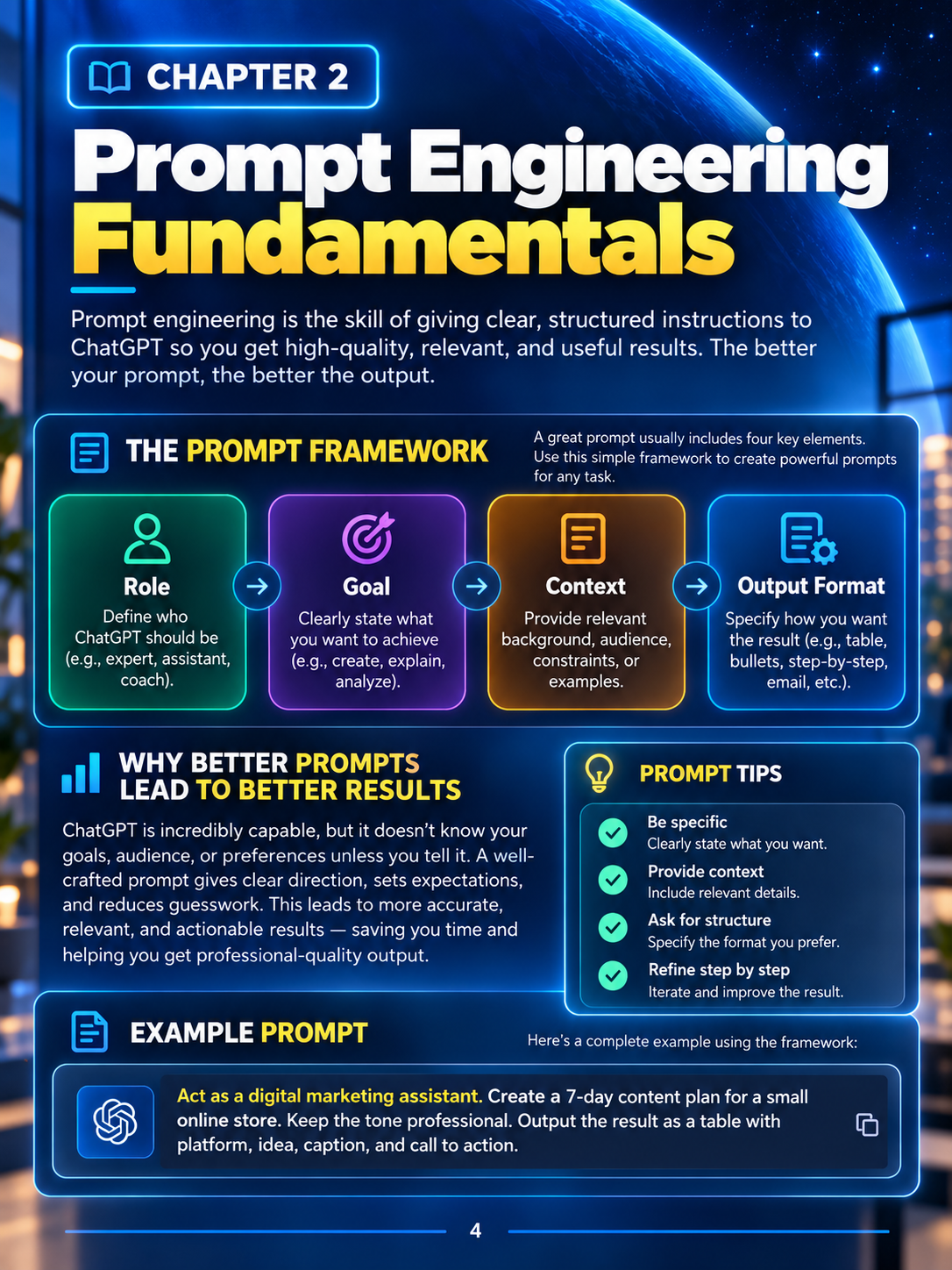
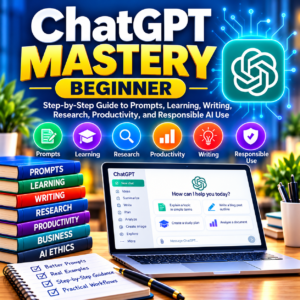
Prompt Engineering for Beginners is designed to help readers move from vague AI requests to clear, structured, professional prompting. The book explains prompt engineering as a practical communication skill rather than a collection of “secret words,” and it teaches readers how to define goals, audience, context, requirements, constraints, and output formats more effectively. Prompt_Engineering_for_Beginners
The main benefits include:
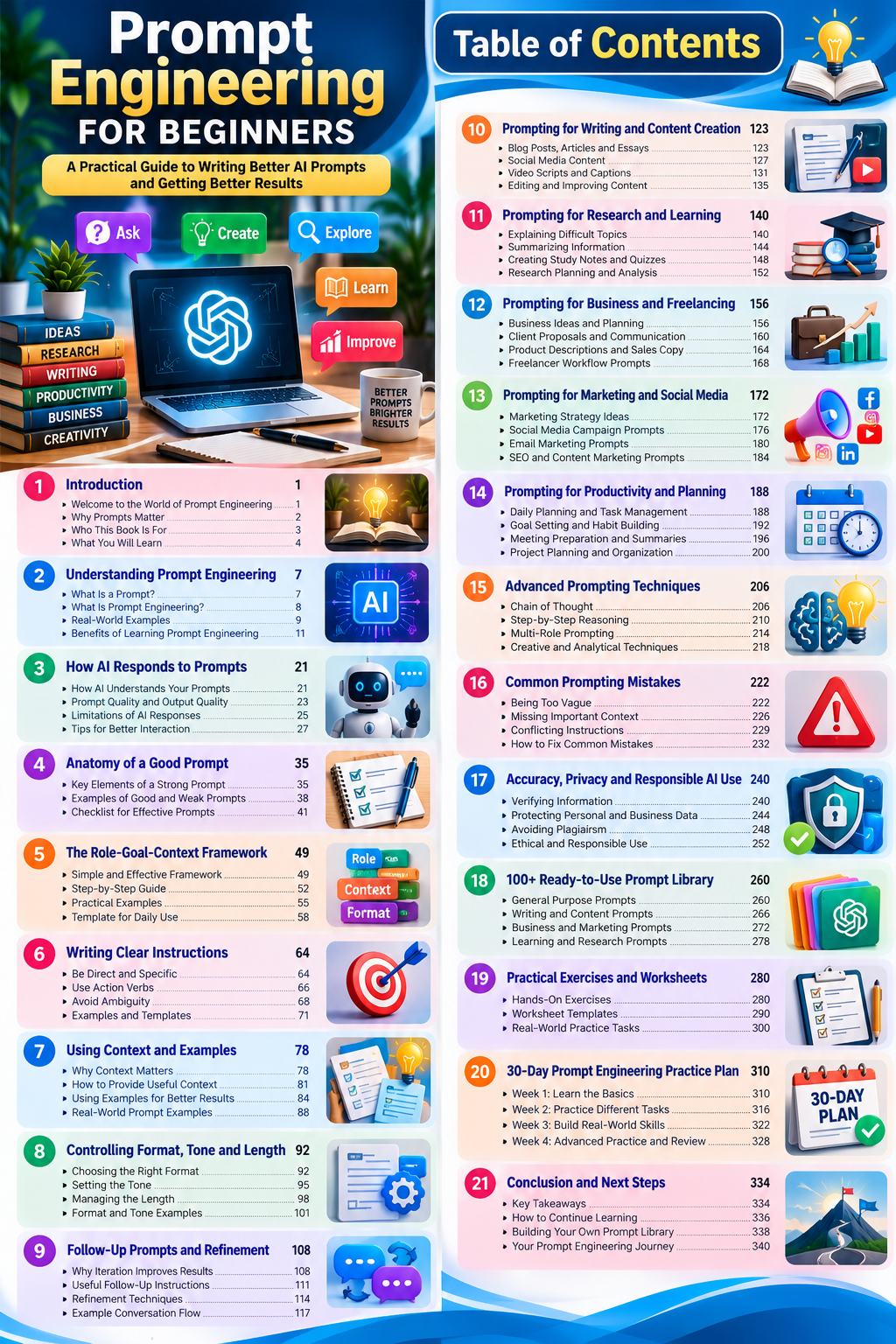
- Write clearer and more effective prompts. Readers learn how to reduce ambiguity and give AI better instructions so responses become more relevant and useful. Prompt_Engineering_for_Beginners
- Understand how AI responds to instructions. The book explains how context, specificity, conflicting requirements, and missing information can affect output quality. Prompt_Engineering_for_Beginners
- Use a practical prompt framework. Readers learn the Role, Goal, Context, Audience, Requirements, Constraints, and Output Format structure for building stronger prompts. Prompt_Engineering_for_Beginners
- Improve writing and content creation. The eBook teaches workflows for brainstorming, outlining, drafting, editing, fact-checking, and repurposing content. Prompt_Engineering_for_Beginners
- Strengthen research and learning skills. Readers learn how to create research questions, identify useful evidence, work with reliable sources, and verify important information instead of treating AI as automatically correct. Prompt_Engineering_for_Beginners
- Build freelancing and business skills. The book covers client discovery, proposals, scope, customer research, assumptions, and responsible client workflows. Prompt_Engineering_for_Beginners
- Improve digital marketing and social-media work. Readers learn how to develop message angles, campaign ideas, platform-specific content, calls to action, and testing hypotheses without relying on exaggerated claims. Prompt_Engineering_for_Beginners
- Increase productivity and planning ability. The book shows how prompts can help create schedules, prioritize work, build checklists, develop SOPs, and organize projects realistically. Prompt_Engineering_for_Beginners
- Learn advanced prompting techniques. Readers are introduced to decomposition, few-shot examples, multiple perspectives, constraints, critique-and-revise methods, and multi-stage prompting. Prompt_Engineering_for_Beginners
- Avoid common prompting mistakes. The eBook explains how to diagnose vague goals, conflicting instructions, overloaded prompts, weak verification, and citation problems. Prompt_Engineering_for_Beginners
- Use AI more safely and responsibly. Readers learn about verification, privacy, data protection, academic/workplace rules, and human accountability. Prompt_Engineering_for_Beginners
- Create reusable prompt systems. Instead of writing every prompt from scratch, readers learn how to build reusable templates with placeholders, quality checks, and versioning. Prompt_Engineering_for_Beginners
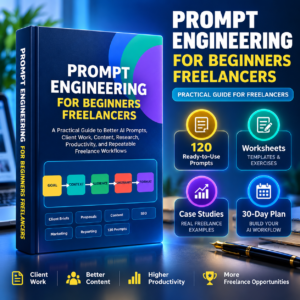
- Access a large ready-to-use prompt library. The book includes more than 100 prompts that can be customized for learning, writing, research, business, marketing, productivity, freelancing, technical work, and responsible AI use. Prompt_Engineering_for_Beginners
- Practice through worksheets and exercises. Readers can work through prompt diagnosis, context filtering, audience adaptation, format testing, refinement, research mapping, client briefing, marketing messaging, and privacy review activities. Prompt_Engineering_for_Beginners Prompt_Engineering_for_Beginners
- Learn from real-world case studies. The book includes practical examples involving student research, freelancing, business content systems, professional communication, and data analysis. Prompt_Engineering_for_Beginners
- Follow a 30-day practice plan. The final workbook guides readers from basic prompt writing to professional workflows, verification, privacy, advanced techniques, and building a personal prompt library. Prompt_Engineering_for_Beginners
Biggest Benefit
The biggest benefit of this eBook is that it teaches readers how to turn AI use into a repeatable skill and workflow. Instead of simply asking random questions, readers learn how to plan prompts, evaluate results, refine weak outputs, verify important information, and save successful prompts for future use.
In short, the book can help readers get better AI results, save time, improve work quality, build professional workflows, and use AI more confidently and responsibly.
Reviews
There are no reviews yet.